
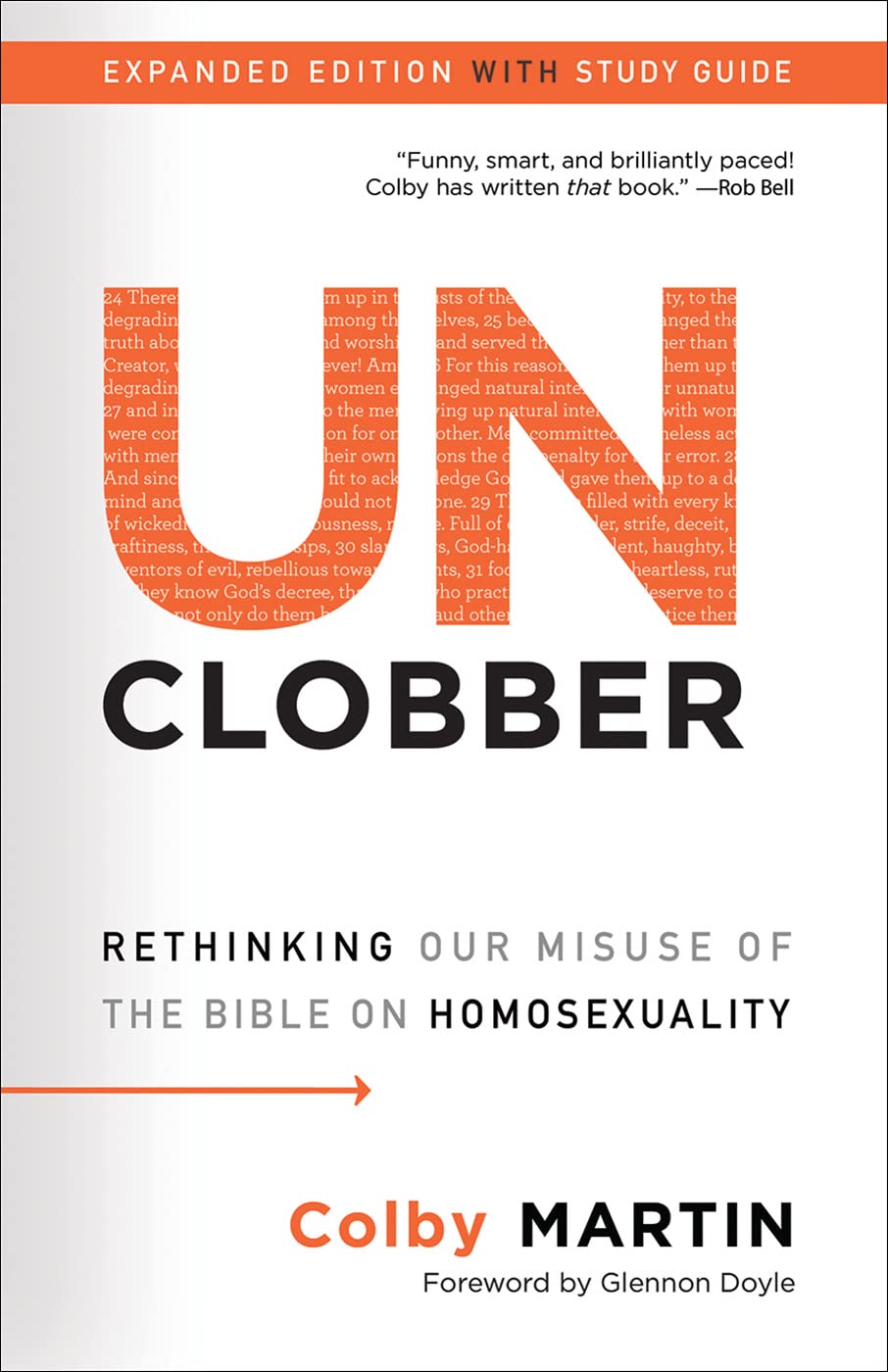
Colby Martin sets out to do two things in UnClobber: Rethinking Our Misuse of the Bible on Homosexuality: share how a conservative evangelical pastor became openly LGBTQ affirming, and reexamine the six “clobber passages” often used to exclude LGBTQ believers. The result is part memoir, part Bible study, and it’s disarming in its honesty.
Martin alternates chapters between story and Scripture. In the narrative chapters, he traces his growing tension between belief and practice—licensed in 2005 while already uneasy with church policies, later losing his job after a Facebook post, and reflecting on moments like apologizing to two dads on a Polar Express train. These moments frame his journey as a pursuit of integrity: aligning inner conviction with outward action. Those personal sections were especially engaging and kept me turning pages.
In the Scripture-focused chapters, he revisits the familiar texts: Sodom as a story of violence and failed hospitality rather than consensual same-sex relationships; Leviticus “abomination” as a marker of ritual boundary rather than universal moral law; Romans 1 in the context of idolatry and exploitation; and the debated Greek terms in 1 Corinthians 6 and 1 Timothy 1. You may not agree with every conclusion, but Martin’s tone remains pastoral and accessible, clearly explaining his reasoning through the historical context and differing understanding of language.
What stood out most was his invitation to consider who is helped—and who is harmed—by the way these passages are used. Martin isn’t trying to win an argument so much as open space for a wider, more compassionate conversation within the church. His posture is captured in a simple prayer he mentions before preaching: “let the good stick; let the unhelpful be forgotten.” I would have appreciated more engagement with non-affirming scholars to better weigh alternative perspectives, but as an accessible introduction for readers navigating tension between compassion and traditional interpretations, the book does what its title promises.
As someone still wrestling with how to hold Scripture and LGBTQ inclusion together, I found UnClobber to be a meaningful step forward. It doesn’t claim to be the final word, but it opens space for thoughtful engagement and offers practical tools for reexamining familiar texts. More than anything, it left me with a renewed sense of hope that growth—both personal and communal—is possible.
At the same time, the book raises an important question: how can churches create space for these conversations without fear of division or backlash? Martin’s story makes clear that change often comes at a personal cost. Still, his example challenges pastors and congregations to approach Scripture with both humility and courage, holding together a commitment to truth and a posture of love.
I’d recommend UnClobber to anyone engaging this topic—whether personally or as an ally. It’s accessible without being simplistic and invites readers into conversation rather than trying to settle it. Martin doesn’t dismiss the authority of Scripture; instead, he asks readers to reconsider how interpretation works and how it might continue to develop in light of compassion and justice.
Overall, UnClobber is a thoughtful contribution to an ongoing and often difficult conversation within the church. By weaving together personal narrative and biblical reflection, Martin offers a perspective that is both challenging and approachable.
I came across this book through a YouTube interview and review by Sean McDowell. His willingness to engage respectfully across disagreement made me more interested in reading it. While he and Martin differ on key points, that kind of dialogue reflects the kind of conversation this book is ultimately trying to encourage.
Leave a Reply